

Backrs

Backrs Institute for Outcomes‑Driven Advising

A semester-long, eight-session professional learning experience for educators dedicated to building a better system for post-secondary, career, and life advising.

Spring 2027 Early Bird List
KIPP NYC Public Schools
Comp Sci High
Compass Rose Public Schools
University of Cincinnati
Institute for Educational Leadership
National College Attainment Network
College Success Foundation
BlueSky Tennessee Institute
UNC Asheville
Achieve Atlanta
Mars Hill University
SchermCo
Harmony Public Schools
Live Oak Camp
Thurgood Marshall Academy
KIPP Metro Atlanta Schools
Memphis Rise Academy
MidPen Housing
KIPP North Carolina Public Schools
Mercy Home for Boys & Girls
TNTP
College Now Greater Cleveland
Capital City Public Charter School
Carolina Youth Coalition
Alliance College-Ready Public Schools
KIPP NYC Public Schools
Comp Sci High
Compass Rose Public Schools
University of Cincinnati
Institute for Educational Leadership
National College Attainment Network
College Success Foundation
BlueSky Tennessee Institute
UNC Asheville
Achieve Atlanta
Mars Hill University
SchermCo
Harmony Public Schools
Live Oak Camp
Thurgood Marshall Academy
KIPP Metro Atlanta Schools
Memphis Rise Academy
MidPen Housing
KIPP North Carolina Public Schools
Mercy Home for Boys & Girls
TNTP
College Now Greater Cleveland
Capital City Public Charter School
Carolina Youth Coalition
Alliance College-Ready Public Schools
Uncommon Schools
DREAM Charter School
Ohio School Counselor Association
Los Angeles Regional Consortium
Memphis Opportunity Scholarship Trust
Noble Schools
LEAD Public Schools
KIPP SoCal Public Schools
Uplift Education
DCI
Valor
Persist Nashville
Mariano Rivera Foundation
KIPP NJ
Asheville City Schools Foundation
The Franklin School of Innovation
Da Vinci Schools
Crosstown High
Erie21 at Le Moyne College
Intrinsic Schools
Wentcher Foundation
YES Prep Public Schools
KIPP Philadelphia Public Schools
Uncommon Schools
DREAM Charter School
Ohio School Counselor Association
Los Angeles Regional Consortium
Memphis Opportunity Scholarship Trust
Noble Schools
LEAD Public Schools
KIPP SoCal Public Schools
Uplift Education
DCI
Valor
Persist Nashville
Mariano Rivera Foundation
KIPP NJ
Asheville City Schools Foundation
The Franklin School of Innovation
Da Vinci Schools
Crosstown High
Erie21 at Le Moyne College
Intrinsic Schools
Wentcher Foundation
YES Prep Public Schools
KIPP Philadelphia Public Schools

Let’s expand what’s possible in advising, together.

The status quo isn't working:

Counselors want to provide students personalized, high touch postsecondary and career coaching. But state mandates, massive caseloads, and limited time make that almost impossible.

As a result, too many young people are entering the modern job market without the insights, skills, or networks they need to land great first jobs. They're finding themselves underemployed or unemployed, struggling to realize their potential in today's economy.

For these twenty-somethings, the promise of an American education remains unfulfilled. And for many of their counselors, the sense of purpose that drew them to the profession feels out of reach.

3%

Only 3% of high-performing, under-resourced students end up in jobs that position them for upward mobility.

52%

52% of college grads end up in jobs that don't require a college degree.

25%

Nearly a quarter of bachelor's degree programs have a negative ROI.

88%

88% of employers say college graduates from the last three years are less prepared for the workforce than in years prior.

Outcomes-Driven Advising is the solution

It begins with students' unique life aspirations, then converts those into personalized postsecondary and career plans that:

  • Optimize for the futures students envision for themselves
  • Prioritize optionality so students lead choice-filled lives
  • Address all of the enduring “unlocks” that drive long-term success
  • Teach stronger mental models for decision-making

It then empowers counselors with the methods and tools they need to help students effectively put these plans into action.

The outcome? Students graduate prepared to succeed on their postsecondary paths and in today's job market. And counselors feel a greater sense of fulfillment knowing they've championed students' goals, not just checked boxes.

“Noble Schools is excited to partner with Backrs...to help our students not just apply to and get accepted into incredible institutions but also guide them in determining best majors and career pathways to follow to give them the highest rate of academic and professional success.”

Michelle Santos

Michelle Santos

Director of College Counseling
Noble Schools logo

“I am excited to partner with Backrs because of the alignment of values between Da Vinci Schools and Backrs, and the opportunity that Backrs will give us to leverage their expertise, research insights, and experience with network partners to help Da Vinci students make good choices on their path to a strong early career.”

Steve Wallis

Steve Wallis

Assistant Superintendent of Educational Services

Da Vinci Schools logo

“We've seen increased student engagement, clearer career direction, and a boost in confidence as students articulate and pursue their goals. It's been a game-changer for helping us meet our mission of preparing students for life beyond the classroom.”

William Clark

William Clark

COOP to Careers Team, University of Cincinnati

University of Cincinnati logo

Institute Details

What's the goal of this institute?

We created this institute to empower educators to implement Outcomes-Driven Advising within their schools.

It's designed to give them a stronger map, a shared methodology, and a practical system for helping students make better decisions and build stronger futures. Through the experience, educators will leverage their strengths, hone their craft, and get reconnected to their “why.”

Graduate in cap and gown hugging an educator at commencementAdvisor working with two students at a tableAn advisor supporting a participant working on a laptop

Meet your facilitators:

Andy Bobowski—Backrs Institute facilitator

Andy Bobowski

Co-CEO & Co-Founder, Backrs

Andy Bobowski is Backrs' Co-CEO and Co-Founder. Before Backrs, he was a school founder, principal, and head of schools, leading principals, teams, and postsecondary strategy. He's on a mission to transform how young people are prepared for strong careers and lives.

Benjamin Maldonado—Backrs Institute facilitator

Benjamin Maldonado

Operations & Data Lead, Backrs

Benjamin Maldonado is driving AI-powered solutions for student success at Backrs. Before that, he worked with organizations like McKinsey & Company, Meta, and LinkedIn, helping leaders build strategies for growth and performance.

The 8 Sessions

TBD90 mins

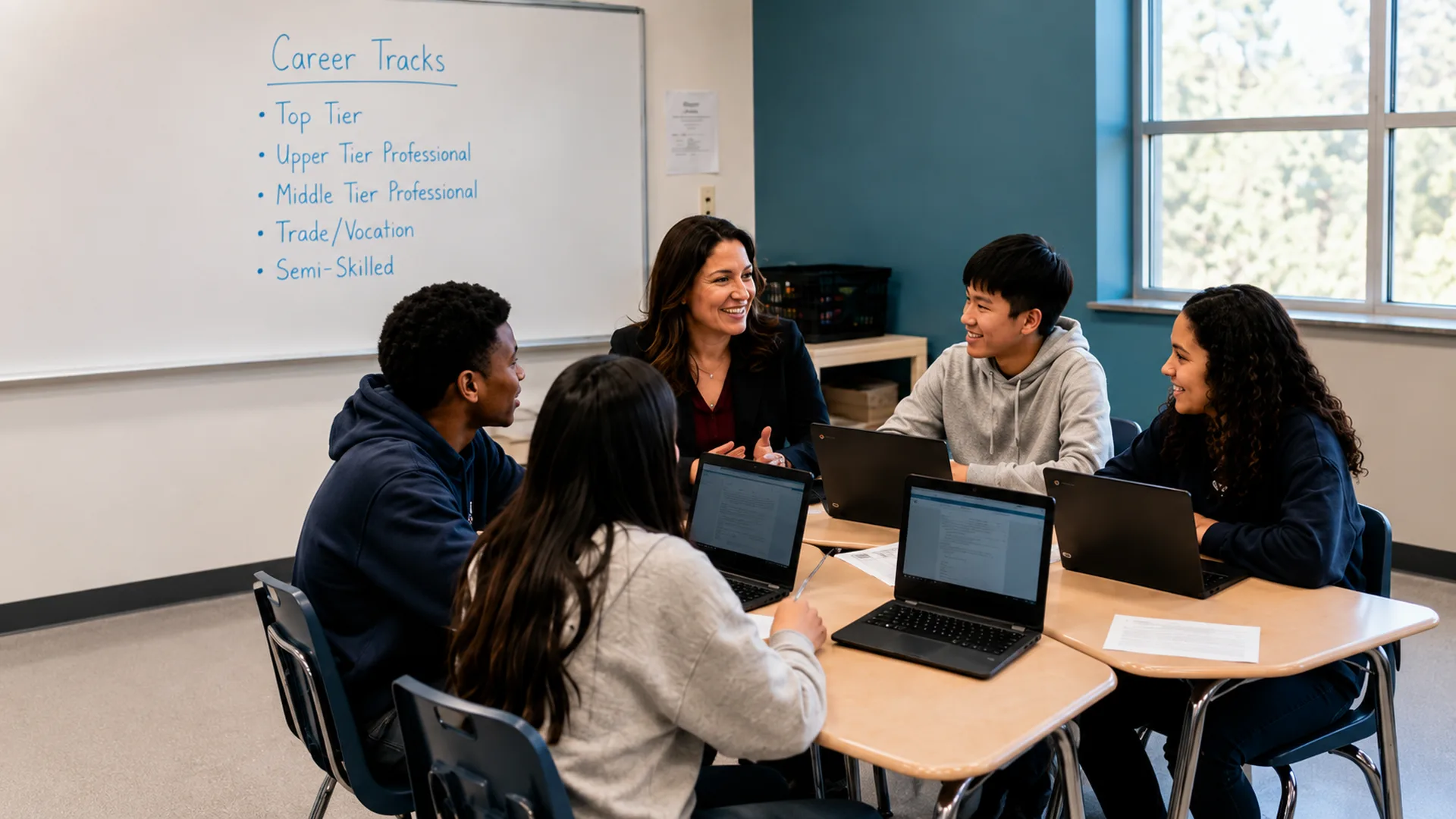
Helping students get clearer on their long-term aspirations not only serves as a powerful advising anchor, but also increases student motivation. Participants learn how to connect life aspirations to career tracks and, subsequently, the many connected pathways.

Key insight

Paths can change many times. Tracks are very difficult to change later on and they matter because they influence the preparation, standards, and options a student needs to preserve in high school and beyond. Awareness of life aspirations increases student motivation and buy in.

What participants will learn

  • How life aspirations can provide direction for academic, career, and postsecondary decisions
  • The difference between career tracks and career paths
  • How to create clarity without forcing students to choose a specific career (or job) too early

What participants will be able to do

  • Lead a conversation that surfaces a student's values, aspirations, lifestyle goals, and vision for adulthood
  • Explain tracks vs. paths in language students and families can actually use
  • Help students explore widely while protecting direction and momentum
TBD75 mins

This session introduces the four Enduring Unlocks that shape long-term student success: Academic Foundations, Real-World Experience and Achievement, Mindsets and Skills, and Communities of Success. Participants will learn what stronger development looks like across each Unlock and how to interpret a student's strengths, gaps, and readiness using a shared set of rubrics.

Key insight

Strong transcripts, marketable degrees--these are all important, but they are not sufficient alone to ensure a student can achieve their career goals. 60-80% of jobs are secured through connections, and employers want to see evidence of workplace-ready competencies gained through real world experience.

What participants will learn

  • What success looks like—based on students' aspirations—across the four Enduring Unlocks
  • How the Unlocks work together to shape readiness and long-term opportunity
  • How to distinguish meaningful evidence of development from activity or busyness

What participants will be able to do

  • Assess a student across all four Enduring Unlocks
  • Interpret evidence using the Backrs readiness rubrics
  • Create a clear, balanced picture of a student's strengths and areas for growth
TBD75 mins

This session focuses on the discipline and skill of prioritization. Participants will learn how to move from a broad readiness assessment to a focused diagnosis of the binding constraint: the issue most limiting the student's trajectory at that moment. From there, they will identify the key lever most likely to create meaningful movement.

Key insight

Ten pieces of decent advice are usually less useful than one piece of sharp advice aimed at the right constraint. Students do not need more to juggle. They need better sequencing.

What participants will learn

  • How to distinguish an important need from the binding constraint
  • How priorities change based on grade level, career track, timing, and student circumstances
  • How to identify hinge moments when a missed action may meaningfully narrow future options

What participants will be able to do

  • Identify the issue most limiting a student's progress
  • Choose one high-leverage priority and explain why it matters now
  • Build a focused action plan that separates what comes first from what can wait
TBD75 mins

This session helps educators bring better evidence into conversations about colleges, credentials, and majors. Participants will learn how to interpret and use institution-level measures such as success rate, median earnings, cost, and return on investment, alongside program-level measures such as employment, underemployment, earnings, and career alignment.

Key insight

A school's brand tells only part of the story. The program, ROI, probability of completion, and career launch matter much more.

What participants will learn

  • What institution- and program-level outcomes data can reveal that rankings, reputation, and input data cannot
  • How school choice, major choice, cost, completion, and labor-market outcomes interact
  • How to use outcomes data responsibly without treating any single measure as the answer

What participants will be able to do

  • Interpret key measures such as success rate, median earnings, ROI, unemployment, and underemployment
  • Compare institutions and programs with more specificity and less reliance on reputation or n=1 examples
  • Introduce outcomes data in ways that strengthen student and family decision-making without taking away student agency.
TBD75 mins

Participants will learn how to run a high-quality Are You On Track? coaching session that reconnects the student to their life aspirations, compares their current progress with the track they hope to preserve, interprets evidence across the Enduring Unlocks, and turns that analysis into a focused plan.

Key insight

Students can receive scores, feedback, and recommendations without understanding what the information means or what should happen next. The value of Are You On Track? comes from the conversation that helps the student interpret the evidence, identify the right priority, and take ownership of the plan.

What participants will learn

  • How to frame Are You On Track? as a comparison to the student's own aspirations, not to other students
  • How to interpret the student's current and target tracks using the Standards by Track and evidence across the four Enduring Unlocks
  • How to move from a broad set of results to one clear priority and a realistic follow-up plan

What participants will be able to do

  • Prepare for and lead a complete Are You On Track? coaching conversation
  • Help a student make sense of strengths, gaps, and conflicting signals in their results
  • Identify one priority, two or three supporting actions, and a clear plan of action
TBD75 mins

This session helps educators diagnose what is preventing a student from moving and respond without relying on encouragement, repeated reminders, or taking over the work. Participants will learn to distinguish among direction, ownership, and execution, then help the student build one practical change that increases both agency and follow-through.

Key insight

It's easy to interpret a student's weak execution as laziness, indifference, or poor motivation. As adults, we often respond with more reminders, stronger consequences, or by completing part of the task ourselves. That may create short-term compliance. It rarely builds long-term agency. The goal is to help the student develop a repeatable way to move themselves forward.

What participants will learn

  • How to distinguish a lack of direction, a lack of ownership, and an execution-skill gap
  • How purpose, agency, response to challenge, and practical systems influence one another
  • How adult support can build student capacity or unintentionally create greater dependence

What participants will be able to do

  • Diagnose why a student is not acting on an agreed priority / plan
  • Choose a coaching response that matches the actual breakdown
  • Help the student build and test one concrete system for greater ownership and follow-through
TBD75 mins

This session helps educators go beyond counting activities and toward evaluating the quality of a student's experience, responsibility, initiative, and contribution. Participants will learn how to interpret evidence across five dimensions of achievement and help students identify the experience most likely to strengthen their readiness, career clarity, and future options.

Key insight

Students are often encouraged to join clubs, volunteer, pursue leadership positions, and stay involved. But participation alone does not tell us much about what a student can do. What matters is the evidence underneath the activity. Has the student shown up reliably for real work? Identified a problem and acted on it? Contributed meaningfully to a team?

What participants will learn

  • What meaningful progress looks like across five dimensions of experience and achievement
  • How to distinguish participation from sustained contribution, responsibility, and results
  • How to identify the type of experience or achievement that would create the most value for a particular student

What participants will be able to do

  • Evaluate a student's existing evidence using the Backrs Achievement rubrics
  • Identify strengths, gaps, and false signals in a student's current profile
  • Help the student choose and pursue one high-value next experience
TBD90 mins

This session helps educators make social capital a deliberate part of college, career, and life advising. Participants will learn how to assess the strength and range of a student's relationships, identify the relational gaps most likely to limit their growth or access, and help students build authentic connections over time.

Key insight

Some students grow up surrounded by adults who can explain how college and careers work, make introductions, review applications, secure internships, and advocate for them in important moments. Other students have similar talent and ambition but far less access to those relationships.

What participants will learn

  • How social capital affects belonging, development, career exposure, information, advocacy, and access to opportunity
  • What stronger development of social capital looks like across peers, strong ties, weak ties, and affinity groups
  • How students can create value, build trust, and maintain relationships before they need to ask for help

What participants will be able to do

  • Assess a student's current social capital using the Backrs Communities of Success rubric
  • Identify the relationship or community gap most limiting the student's growth or access
  • Help students take practical step to strengthen an existing relationship or create a new one

Join the Spring 2027 Early Bird List

Be the first to know when registration opens and get an exclusive discount on enrollment:

Learn more about Outcomes-Driven Advising

Watch these short talks to preview some of the material you’ll learn at the Backrs Institute.